
Air in the Crop Area of a Parrot (Scarlet Macaw) – A Real Case from an Owner’s Experience
When I decided to start a blog about parrots, I made a conscious decision to describe real situations that I personally face as a parrot owner and breeder.
This article is based on my experience with a scarlet macaw and a problem that initially caused me serious concern: visible air accumulation in the area of the crop and under the skin of the neck.
This is not a guide or a treatment manual. It is a description of one specific case, showing how misleading the initial appearance of a situation can be.
The Beginning of the Problem
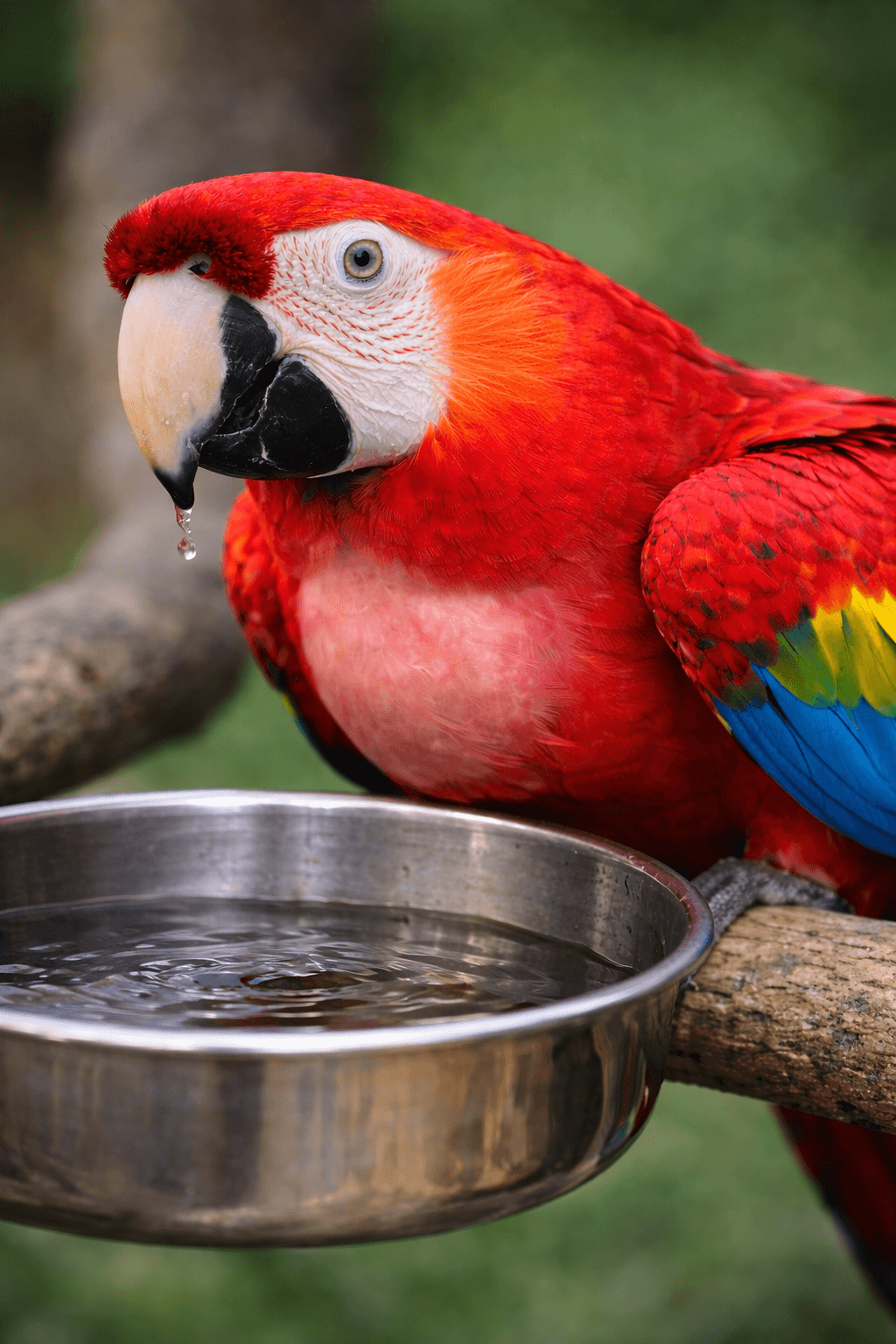
I noticed an unusual swelling on the left side of my parrot’s neck, just below the ear.
The skin appeared as if it were gently inflated with air.
At the moment this symptom appeared, it was not clear whether we were dealing with an active disease process or with the aftermath of a condition that had already passed.
What was most confusing was that at the same time the parrot:
– had a very good appetite,
– was active,
– flew normally,
– behaved exactly as usual.
On one hand, there was a visible abnormality; on the other, a bird that appeared completely healthy.
Initial Concerns and Observation
In such a situation, it is natural to consider various possibilities related to the crop or the digestive tract.
After consultation and only under the supervision of a veterinarian, pharmacological treatment was introduced, taking into account a possible infectious background.
After several days of observation, it became clear that:
– the parrot’s general condition remained very good,
– appetite did not change,
– and the visible air persisted.
The lack of a clear response to the initial approach proved to be an important observational finding.
Treatment Used in This Case (Informational Only)
In this specific case, exclusively under veterinary supervision, the following treatment was applied:
– an azole-group antifungal medication (fluconazole),
– a broad-spectrum antibiotic.
After several days, no significant change in the presence of air was observed, despite the parrot remaining in excellent condition.
This information played an important role in the further evaluation of the situation.
At a later stage, again in consultation with the veterinarian, the approach was adjusted to include:
– ronidazole, a substance used when anaerobic bacteria or protozoa are suspected,
while continuing careful monitoring of the bird’s condition and maintaining a cautious, supportive care approach.
This description applies only to this single case.
A Key Observation
During further observation, a crucial detail became clear:
The crop itself was functioning normally.
The parrot ate without difficulty, and food passed through as expected.
The air was not located inside the crop lumen but under the skin, on the left side of the neck.
This significantly changed the understanding of the entire problem.
What Could This Mean?
The most likely explanation was:
– previous tissue irritation,
– a microscopic leakage,
– or a subcutaneous air pocket remaining from an earlier disease process.
This was not an active inflammatory condition, but rather a stage of tissue regeneration.
This distinction proved crucial both for further observation and for maintaining peace of mind.
The Hardest Part: Patience
The most difficult part of the entire situation was not treatment, but waiting.
The air decreased very slowly and did not disappear overnight.
Throughout this period, the parrot:
– ate normally,
– remained in good physical condition,
– showed no signs of breathing difficulty,
– displayed no signs of pain or discomfort.
Over time, it became clear that the body simply needed time to resolve the remaining effects on its own.
Why This Approach Made Sense
At the time decisions were made, it was not possible to clearly determine whether the observed symptom resulted from an active disease process or from its aftermath.
In hindsight, this approach had value not only therapeutically but also diagnostically. It helped confirm that there was no active infection and that the parrot’s body was functioning properly.
The lack of deterioration and the gradual resolution of the symptom indicated that no further intensive intervention was required, and that the body primarily needed time to regenerate.
This case showed that sometimes treatment serves mainly to clarify the situation and allow the body to complete the healing process calmly.
Conclusions from This Case
This experience highlighted the importance of:
– careful observation,
– calm decision-making,
– cooperation with a veterinarian.
Not every visible change indicates an emergency, but every change deserves attention. Sometimes the greatest challenge is not taking action, but knowing when to intervene and when to allow the body to recover.
Important Notice
The content of this article is provided for informational purposes only and is based on the author’s personal observations and experience. It does not constitute veterinary advice, a medical diagnosis, or treatment instructions. All decisions regarding a bird’s health should always be made in consultation with a qualified veterinarian.












Comments